Transform any application or system
Into an agentic capability
Auto-generate Model Context Protocol tool definitions from REST, GraphQL, SOAP, or gRPC API's or databases. Self-hosted in your VPC or on-prem. Nothing leaves your network.
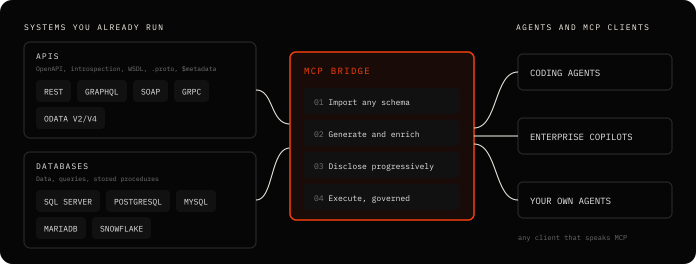


AI that delivers
Legacy and most existing APIs weren't designed for a world where the consumer is an LLM. Schemas lack semantic context, tool boundaries are ambiguous, and payloads burn through context windows.
Expose, govern, and optimize LLM, MCP, and API resources through a single point of control. No integration sprawl, and no hundreds of individual MCP servers to build and maintain.
for developers
Ship an MCP server in 2 minutes. Not 2 weeks.
Stop writing tool definitions by hand. Point MCP Bridge at any schema URL and every operation becomes a fully typed, annotated MCP tool, ready for Claude, GPT, Gemini, or any MCP-compatible client.
# Pull and run MCP Bridge
$ docker run -d \
  --name mcp-bridge \
  -p 8080:8080 \
  -v ./bridge.yaml:/app/config.yaml \
  appfactor/mcp-bridge:latest

# Point any MCP client at the endpoint
$ curl https://localhost:8080/mcp/tools
→ 42 tools generated · ready
apis:
  - name: "payments"
    protocol: "rest"
    schema: "https://api.acme.io/openapi.yaml"
    auth:
      type: "oauth2"
      flow: "client_credentials"
    code_mode: true     # 98% less context

observability:
  otel: true
  log_level: "info"
# Auto-generated tools, ready for any LLM
tools_generated: 42
protocols: [rest, graphql]
annotations:
  read_only: 28
  idempotent: 31
  destructive: 4
avg_tokens_per_tool: 487
code_mode_tokens: 960  # vs ~48,000 raw

Schema-driven
OpenAPI 3, GraphQL introspection, WSDL, and .proto files. All parsed automatically.

Self-hosted
Docker container on AWS ECS, Azure Container Apps, or any orchestrator. Your data never leaves your network.

Built in Rust
Memory-safe, high-throughput, production-ready. Zero external SaaS dependencies at runtime.
How it works
From API to AI-ready tool in four steps.
Import API schemas
Provide a schema by URL, paste it in, or upload files. OpenAPI (JSON/YAML), GraphQL introspection, WSDL, and gRPC via server reflection or .proto files. SOAP auth is detected and pre-configured.
Generate and enrich tools
Each operation becomes a typed MCP tool with output schemas, inferred annotations and rich descriptions. Optional AI Enrichment rewrites weak names and descriptions.
Disclose progressively
MCP Resources, hybrid search and Code Mode let agents find the right tool instead of loading every definition. A 500-endpoint API still fits in a working context window.
Execute, governed
Guardrails, validation and optional human approval before the call. Response shaping and output guardrails after it. The backend authorises the real user behind every request.
Not a gateway
Built for AI agents, not just HTTP traffic.
API gateways route HTTP requests. MCP Bridge does something fundamentally different. It translates APIs into semantically rich tool definitions LLMs can reason about, select correctly, and call efficiently.
It handles what gateways were never designed for: tool curation, response post-processing to reduce token waste, context window management, and AI-specific observability across latency, throughput, token usage, and error rates.
Code Mode
~98% less
Three meta-tools replace hundreds of individual tool definitions. The LLM discovers tools on demand and orchestrates multi-step workflows in a sandboxed QuickJS runtime with a 30-second timeout. Same capabilities, a fraction of the token cost. Available on Team and Enterprise.
Standard: 100+ tool definitions
Code Mode: 3 meta-tools
Capabilities
Enterprise-ready, on day one.

Tool curation
Enable, rename, edit descriptions, customize parameter mappings, and configure per-tool response processing.

Response post-processing
Per-tool declarative rules (unwrap, select, exclude, limit, sort, flatten, aggregate) or custom JavaScript transforms in a sandbox.
Human-in-the-loop
Destructive tools can require human approval before they run. Agents can prompt for missing parameters instead of guessing. Every approval is audit-logged.

Enterprise auth
Bearer, Basic, API key, OAuth2, AWS Cognito SRP, WS-Security for SOAP, gRPC TLS/mTLS. OIDC for the web UI with Entra ID, Keycloak, Auth0, Okta.
On-Behalf-Of identity
The backend authorises the real user behind every agent request, not a shared service account. Token exchange (RFC 8693), bearer pass-through or signed identity injection. Fails closed.

Analytics dashboard
Latency, throughput, per-tool and per-API metrics, token usage breakdowns, error rates. O-Tel in Enterprise.
SOC 2 compliance
Append-only audit trail, AES-256-GCM credential encryption, session security, login rate limiting, credential rotation alerts and automatic log retention.

Tool annotations
Read-only, destructive, idempotent, and open-world hints auto-inferred from API semantics. Output schemas tell agents what comes back. Editable per tool.

Semantic tool search
Hybrid search with full-text, trigram fuzzy matching, and optional vector similarity via pgvector and HNSW.
AI security guardrails
Input guardrails catch prompt injection in tool arguments. Output guardrails scan responses across 32 detector categories, from cloud keys to PII, and log or redact.

Self-hosted
Runs in your VPC or on-prem on AWS ECS, Azure Container Apps, or any orchestrator. Read-only replicas scale execution independently. Zero external SaaS dependencies.

Reliability
Per-API token bucket rate limiting, exponential backoff with jitter, configurable retry policies, health checks.
Who it's for
Built for the teams making AI work in production.
Platform Engineering
Expose internal APIs to AI agents
Without writing or maintaining MCP adapters for each service. Import schemas, configure auth, and expose governed tools through a single control plane.
AI Engineers
A managed tool layer for agents
Build agents that call enterprise APIs with authentication, rate limiting, response post-processing, and observability built in, not bolted on.
Enterprise Organizations
Bridge your API portfolio to MCP
Adopt MCP as a standard. Bridge your existing API portfolio to LLM clients quickly, and govern it centrally as adoption grows.
Give your AI agents the data access they need.
Three tiers. Unlimited tool calls on every one. Available on AWS and Azure Marketplace, or licensed direct.